

Three guidelines for correct farriery
Many seasoned horseman will admit that success in any discipline of horse sport is dependent on healthy hooves.
As the winter show season reaches its peak, hoof care is paramount and the importance of good quality hoof care of the competition horse can’t be denied. The equine hoof is unique, as it is comprised of a group of biological structures that follow the laws of biomechanics. To that end, the farrier is a major asset during the show season as he or she can be proactive in maintaining the health of a horse’s foot and help to prevent lameness.
There are three very important aspects of farriery science that the farrier will use to keep any horse sound:
The Trim: Trimming the foot in conjunction with the size and placement of the horseshoe. Typically, a farriery session will begin with an evaluation of the conformation of each hoof from the front, side, and behind to observe the height of the heels. Next, the farrier should observe the horse in motion to see whether the horse’s foot lands heel first, flat or toe first. Regarding the trim, many farriers no longer use the term ‘balance the foot’ – which has no meaning – and have begun to use guidelines or landmarks when approaching the trim.
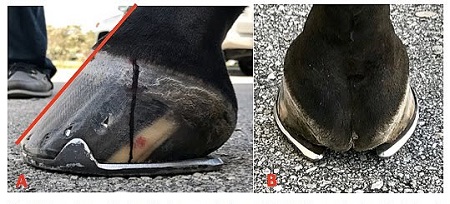
The guidelines used are trimming to achieve a straight hoof-pastern axis; using the widest part of the foot which correlates to the center of rotation; Trimming the palmar foot (heels) to the base of the frog or to the same plane as the frog.
Center of rotation (COR): As the COR is located a few millimeters behind the widest part of each foot, it allows the farrier to apply appropriate biomechanics to each foot. The foot is trimmed in approximate proportions on either side of the widest part of the foot, which provides biomechanical efficiency.
The Heel: One should trim the palmar section of the foot to the base of the frog or trim such that the heels of the hoof capsule and the frog are on the same plane. Adherence to this guideline keeps the soft tissue structures (frog, digital cushion, ungula cartilages) within the hoof capsule, which are necessary to absorb concussion and dissipate the energy of impact.
These three guidelines can be applied to any foot and they serve as a basis for maintaining a healthy foot, as well as a basic starting point for applying farriery to a horse with poor foot conformation or one with a distorted hoof capsule.
Source: Press release Palm Beach Equine Clinic
photo: Foot shows the three guidelines applied to the foot. Note the proportions on either side of the widest part (black line) of the foot. Right: Shows the length of the shoe and the wide expanse of the shoe creating a platform under the foot.
www.equineclinic.com