
Heat and Performance: Nutrition, Hydration, and Efficiency in Equestrian Sport
Heat, in competition settings, is almost never regarded as a decisive factor in the success of a performance. It does not appear in schedules, nor is it listed among the “official variables,” yet—especially during summer events—it remains a constant presence, silently altering balances that once seemed firmly established.
Riders perceive it clearly, even without data or measurements to support the sensation: beyond habit, beyond the normality of working under the sun, and beyond the almost automatic discipline that this sport demands, the body begins to react differently, often before the mind becomes fully aware of it.
It is a subtle shift in equilibrium that disrupts rhythm and is frequently underestimated until it manifests itself through tangible effects on performance quality.
In recent years, scientific literature has begun to formally acknowledge something that those who live this sport daily—regardless of the season—had already learned to recognise: heat directly affects energy expenditure, heart rate, and perceived exertion.
One could almost say that no study was necessary to notice it. Yet the real question is another: what does all this mean, in practical terms, for a rider? Quite simply, it means that, for the same amount of work, the body is forced to expend more energy while simultaneously struggling to maintain the same level of efficiency. In other words, one works harder to achieve less.
And this is where an aspect often managed too superficially comes into play: nutrition.
Because when temperatures rise, something very concrete happens: perspiration increases, fluids and electrolytes are lost, while appetite tends to decrease. The result is a paradox: precisely when more energy is needed, the rider is inclined to consume less.
The problem does not appear immediately, and perhaps this is what makes it particularly insidious. As we have already discussed in previous articles in the NutriEquilibrio column, there is rarely a sudden collapse, but rather a gradual decline in performance.
Under these conditions, carbohydrates—often unfairly demonised or handled carelessly—regain a central role, as they represent the body’s most immediate source of energy. When work becomes more intense or prolonged, they become essential for maintaining mental clarity, coordination, and quick reflexes: three fundamental elements in any equestrian discipline.
This does not necessarily mean eating more, but rather eating better and, above all, at the right time. A light, easily digestible intake before training or competition can make a substantial difference.
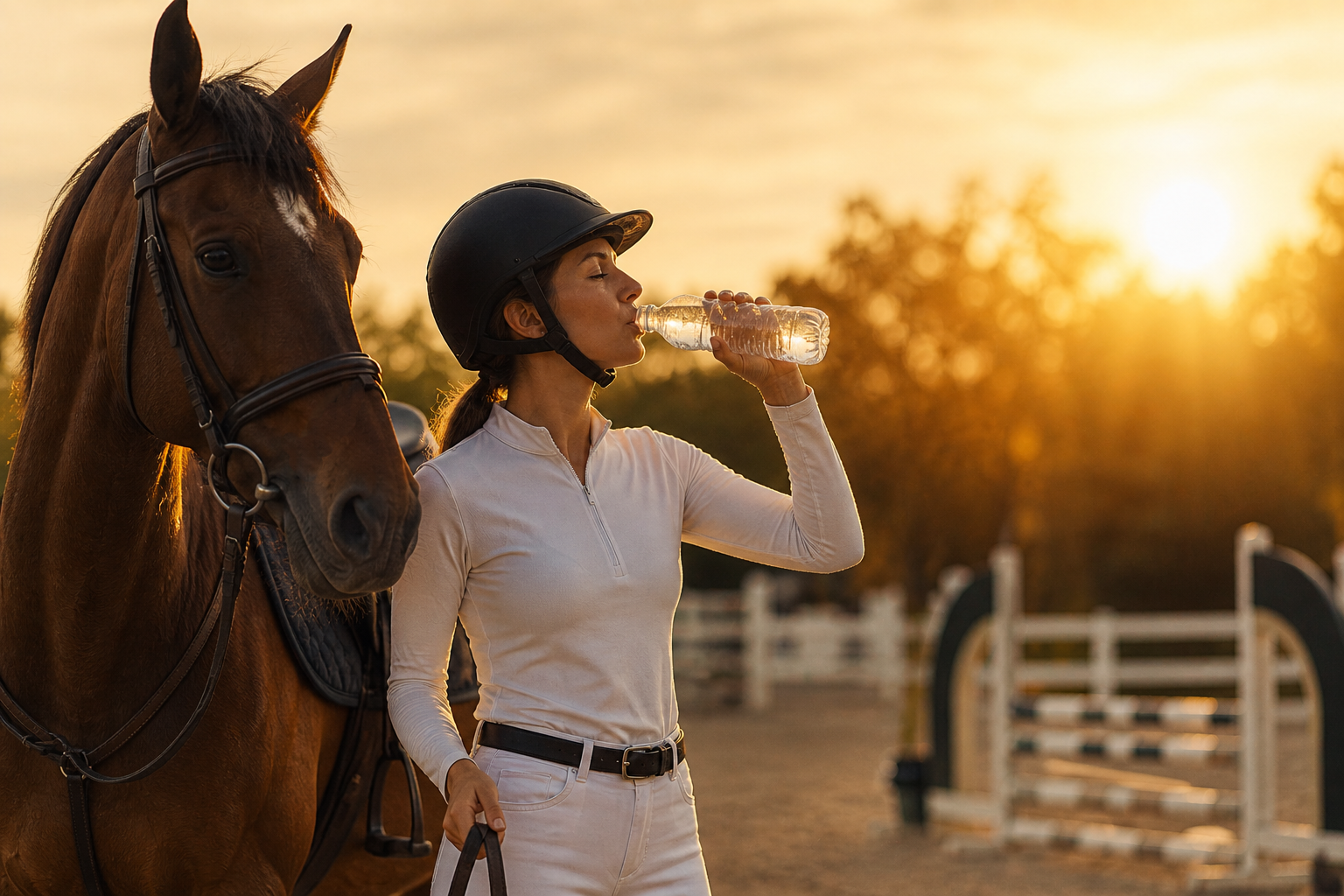
Then there is hydration, which deserves a discussion of its own. Drinking “when thirsty” is, quite simply, already too late. The body begins to lose efficiency long before thirst becomes evident, and within the context of a competition or training session—where time is limited and priorities are numerous—it is easy to overlook.
Research is unequivocal: even mild dehydration can increase heart rate, worsen the perception of effort, and reduce concentration capacity. In more severe cases, it may even lead to fainting. Taken together, these factors directly compromise the quality of work in the saddle, while also endangering the rider.
To complicate matters further, riding apparel cannot simply be adjusted at will. Helmets, jackets, and protective equipment all contribute to retaining heat, making the body’s cooling mechanisms less effective.
It is a cumulative condition that helps explain why, on certain days, even highly prepared riders may appear less efficient than usual.
Managing heat and performance, therefore, is far from being a secondary issue. Inevitably, it also depends on what one eats and drinks, even before considering what happens in the arena.
Alessandra Ceserani
© Rights Reserved.