


The Evolution of FEI Dressage Rules at the World Equestrian Games
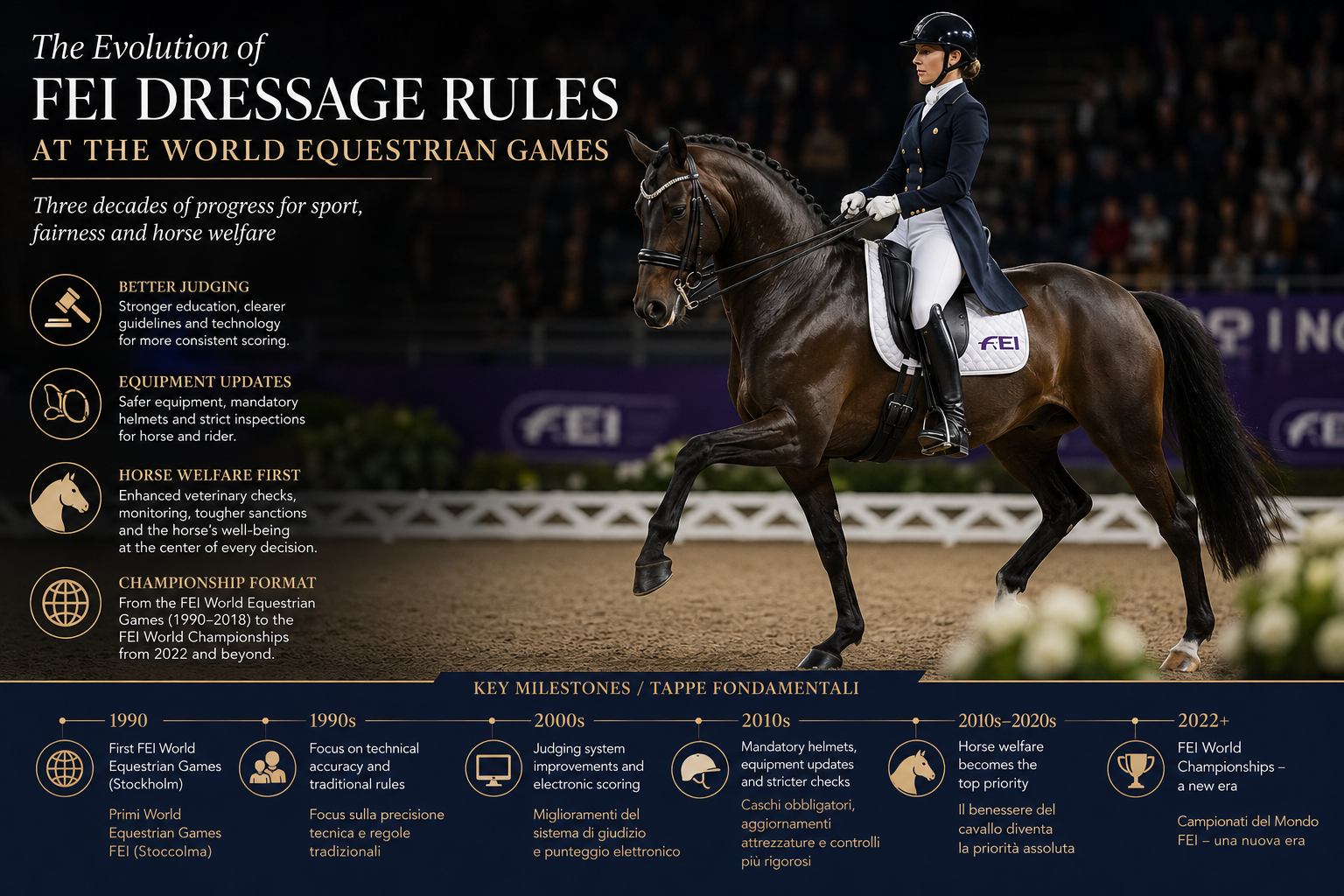
Dressage has long been regarded as one of the most technical disciplines in equestrian sport. At the FEI World Equestrian Games (WEG), and now the FEI World Championships, riders compete at the highest international level under rules designed to ensure fairness, consistency, and the welfare of the horse. Since the first World Equestrian Games in 1990, FEI dressage rules have undergone significant changes. These developments reflect advances in judging, equipment, horse welfare, and the expectations of modern sport.
The Beginning of the FEI World Equestrian Games
The FEI World Equestrian Games were introduced in 1990 in Stockholm, Sweden, bringing all FEI disciplines together in one major championship held every four years. Dressage quickly became one of the event’s highlights, featuring both team and individual competitions. The championships served as an opportunity for the FEI to apply a unified set of international rules and judging standards across all participating nations.
Early Dressage Rules
During the 1990s, FEI dressage focused primarily on technical accuracy. Judges rewarded precision, obedience, rhythm, impulsion, and harmony between horse and rider. Movements such as piaffe, passage, pirouettes, flying changes, and extended gaits formed the foundation of Grand Prix competition.
Equipment rules were relatively traditional. Double bridles were compulsory at championship level, tail bandages were permitted during warm-up, and many riders competed wearing traditional top hats rather than protective helmets. Although horse welfare was always included in the FEI rulebook, the standards and monitoring procedures were less detailed than they are today.
Improvements in Judging
One of the biggest changes over the past three decades has been the judging system. Early championships often produced criticism because scores varied considerably between judges. To improve consistency, the FEI introduced stricter education and evaluation programs for judges, statistical monitoring of scoring patterns, and clearer guidance for evaluating each movement.
Collective marks have also evolved. Greater emphasis is now placed on the quality of the horse’s gaits, submission, and the rider’s effectiveness while maintaining harmony throughout the test.
The FEI has also expanded the use of technology. Electronic scoring systems, instant calculation of marks, and detailed score analysis have increased transparency for riders, officials, and spectators.
Changes to Equipment
Equipment regulations have gradually shifted toward improving horse comfort and rider safety.
Several important developments include:
• Mandatory protective helmets replacing top hats at FEI competitions.
• Regular updates to the list of permitted bits, nosebands, and saddlery.
• Stricter inspections by stewards before and after each test.
• More detailed rules governing warm-up equipment and training methods.
These changes have reduced the risk of inappropriate equipment while promoting a more consistent standard across international competitions.
Horse Welfare Takes Center Stage
Perhaps the most significant change has been the FEI’s increasing focus on horse welfare. Public expectations and scientific research have encouraged governing bodies to strengthen welfare regulations.
Recent rule developments include:
• Enhanced veterinary inspections before competition.
• Closer monitoring of horses in the warm-up arena.
• Immediate investigation of any signs of blood or injury.
• Increased authority for stewards and ground juries to intervene when horse welfare is compromised.
• Stronger sanctions for abusive riding or inappropriate training methods.
These measures reinforce the FEI’s principle that the welfare of the horse must always take precedence over competitive success. Recent discussions within the FEI have continued to focus on judging standards, test design, and welfare-driven rule revisions.
Changes to Championship Format
The World Equestrian Games remained the home of the FEI Dressage World Championship from 1990 through 2018. However, after logistical and financial challenges associated with hosting all FEI disciplines together, the organization decided to discontinue the WEG format.
Beginning in 2022, dressage returned to standalone FEI World Championships held alongside selected disciplines rather than as part of one large multi-sport event. While the venue changed, the championship status and FEI dressage rules remained in place.
The Modern FEI Rulebook
Today’s FEI Dressage Rules extend well beyond judging movements inside the arena. The regulations cover horse inspections, athlete eligibility, equipment, stewarding, veterinary procedures, anti-doping controls, biosecurity measures, and welfare requirements.
Recent revisions have also introduced greater flexibility in certain equipment regulations at lower FEI levels while preserving the highest standards required for championship competition. The FEI continues to review its rulebook regularly to reflect new research, feedback from riders and officials, and developments in equine welfare.
Conclusion
The evolution of FEI dressage rules mirrors the evolution of the sport itself. Early championships emphasized technical precision and tradition, while modern regulations place equal importance on transparency, safety, consistency, and horse welfare. Although the World Equestrian Games no longer exist in their original format, the FEI World Championships continue to showcase the highest level of dressage under a rulebook that continues to adapt to the needs of both athletes and horses. As the sport moves forward, future rule changes are expected to strengthen welfare standards further while preserving the classical principles that define international dressage.
© Rights Reserved.