

The Evolution of the FEI Show Jumping World Championships
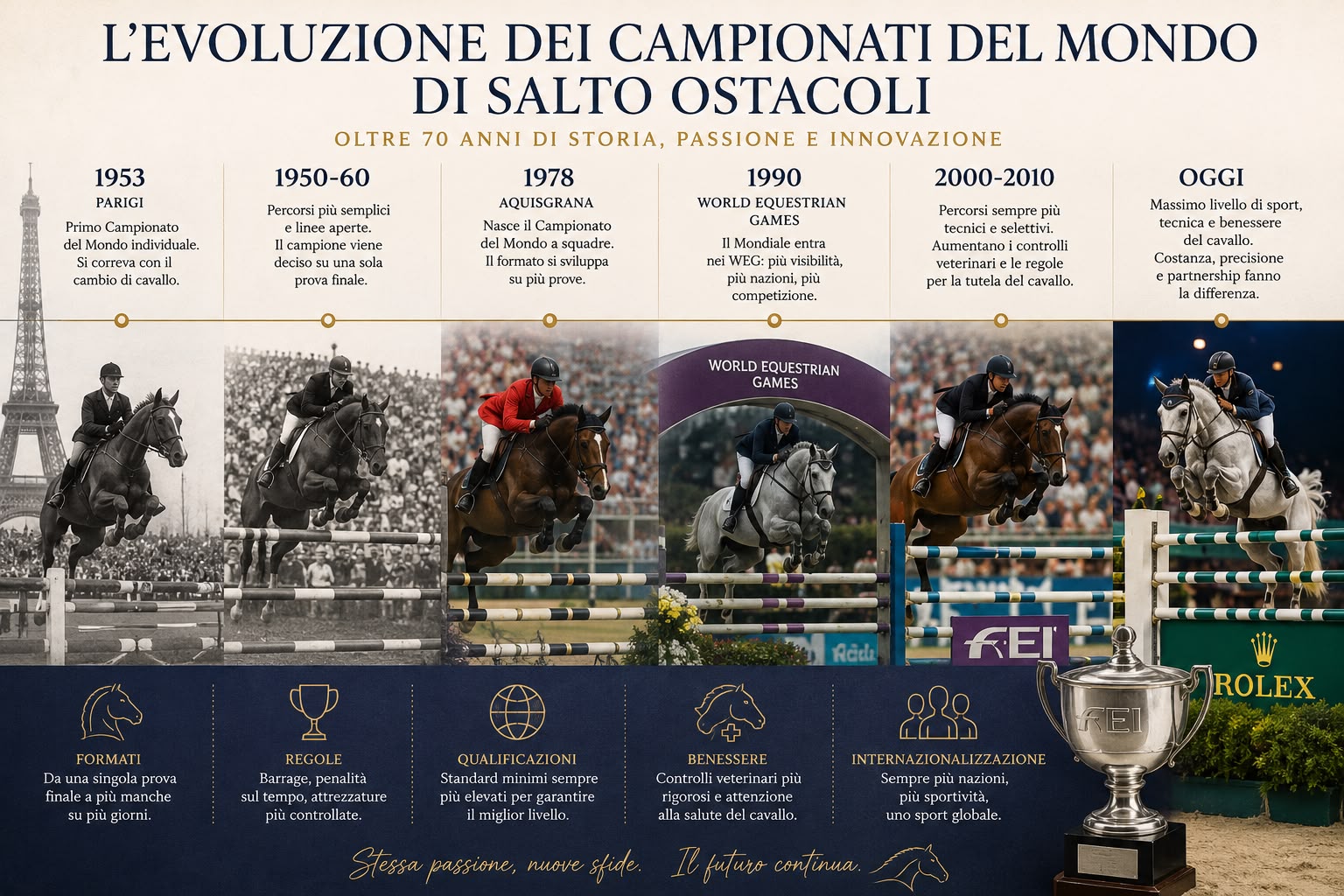
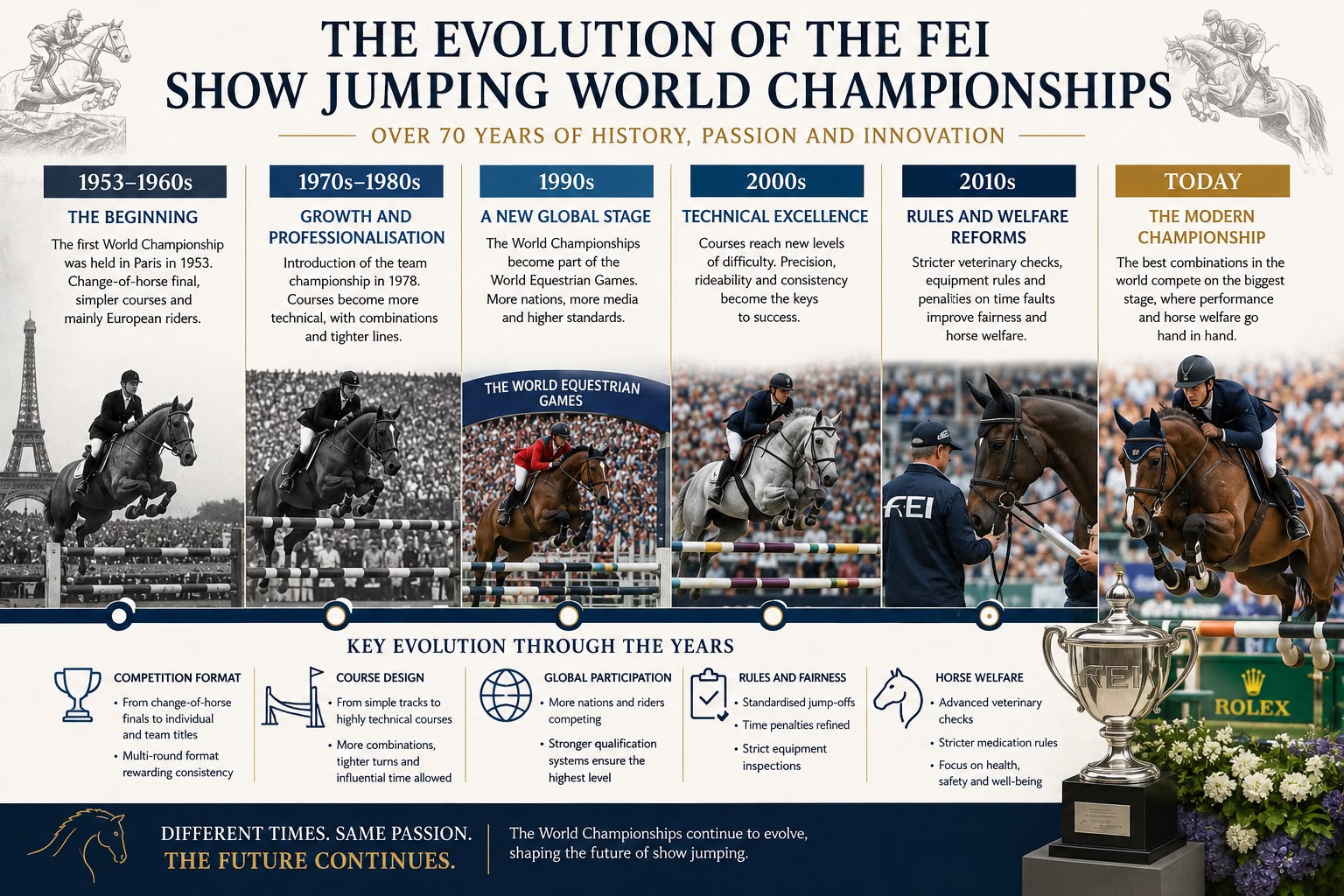
Since the first FEI World Championship was held in Paris in 1953, show jumping has undergone continuous transformation. The championship has evolved from a relatively small competition dominated by European riders into one of the most technically demanding and globally recognised events in equestrian sport. Along the way, changes in competition formats, course design, qualification systems, judging, and horse welfare have shaped the modern championship that riders compete for today.
The Beginning: 1953 to the 1960s
The inaugural World Championship in Paris marked the first official individual world title in show jumping. At the time, the competition was relatively straightforward. Championships were smaller, attracting mainly European nations, and the focus was on identifying the best individual rider and horse combination rather than crowning a team champion.
One of the most distinctive features of the early championships was the change-of-horse final. The leading riders competed on each other’s horses, testing not only their technical ability but also their adaptability. This format reflected the belief that a true world champion should demonstrate skill regardless of the horse beneath them.
Several important rule changes appeared during this period. In 1955, the World Championship introduced its first jump-off to decide the gold medal after a tie. The same edition also removed the automatic qualification previously granted to the defending champion, ensuring that every rider had to earn their place through competition.
Course design during these early years remained relatively uncomplicated compared with modern standards. Riders encountered fewer combinations, wider galloping lines, and less technical track planning. The challenge relied largely on the horse’s scope and carefulness rather than on complex questions of rideability.
Expansion and Professionalisation: The 1970s and 1980s
By the 1970s, the World Championships had become significantly more competitive. Participation increased as more nations invested in international show jumping, raising the standard of competition and forcing organisers to rethink the championship format.
One of the most significant milestones came at the 1978 World Championships in Aachen. For the first time, an official team championship was introduced alongside the individual title. The new format combined several competitions over multiple days, including a Nations Cup and qualifying rounds before the individual final. This structure rewarded consistency rather than a single exceptional performance and remained the basis of the championship for many years.
Course designers also began to change their philosophy. Instead of testing only jumping ability, they designed courses that demanded accuracy, balance, rhythm, and careful planning. Triple combinations became more common, distances required precise stride management, and tighter turns placed greater emphasis on the partnership between horse and rider.
The championships also benefited from increasing television coverage, bringing show jumping to a wider international audience and attracting greater commercial interest.
The World Equestrian Games Era: 1990 to 2018
A major turning point came in 1990 with the introduction of the FEI World Equestrian Games. For the first time, the Show Jumping World Championship was held alongside other FEI disciplines at one large international event. This increased media exposure and brought the sport to new audiences around the world.
As the championship expanded, qualification systems became more rigorous. Riders and horses were required to achieve minimum eligibility standards through international competitions before earning a place at the World Championships. This ensured that the championship field represented the highest level of international competition.
Competition formats also evolved. Instead of relying on a single decisive class, championships were spread across several rounds. Penalties accumulated over multiple competitions before determining the finalists, rewarding combinations capable of maintaining consistent performances over several days.
Course design reached a new level of sophistication. Technical lines, narrow fences, delicate combinations, careful time allowed, and visually demanding obstacles became defining features of championship courses. Success depended as much on tactical riding and precision as on jumping power.
Modern Rule Changes
Over the last two decades, the FEI has introduced numerous rule changes aimed at improving fairness, consistency, and horse welfare.
Time penalties have become increasingly influential in championship results. Adjustments to the way time faults are calculated have encouraged riders to maintain a more accurate pace without compromising safety.
Equipment regulations have also become stricter. Warm-up procedures are now closely monitored, restrictions on training methods have increased, and stewards carry out more comprehensive tack inspections before and during competition. These measures are intended to ensure equal conditions for all competitors while protecting horse welfare.
Veterinary controls have expanded considerably. Horses now undergo detailed inspections before competition and throughout the championship. Medication regulations have become more stringent, reflecting the FEI’s increasing emphasis on clean sport and responsible horse management.
The championship rules themselves continue to be updated regularly, with refinements to qualification procedures, scheduling, and competition structure designed to improve both sporting fairness and logistical efficiency.
Today’s Championship
The modern FEI Show Jumping World Championship is very different from its 1953 predecessor. While the objective remains the same, identifying the world’s best horse and rider combination, the path to the title has become far more demanding.
Today’s champions must perform consistently across several rounds against the strongest international field in history. They face highly technical courses designed to test every aspect of horsemanship, from precision and balance to tactical decision-making and partnership with the horse.
Perhaps the greatest evolution has been the growing emphasis on horse welfare. Modern championships place equal importance on sporting excellence and responsible horsemanship, ensuring that the welfare of the horse remains central to every aspect of the competition.
More than seventy years after the first World Championship, the event continues to evolve. New rules, advances in course design, improved veterinary science, and the increasing global reach of the sport ensure that each generation of riders faces a championship that is both different from, and more demanding than, the one before.
© Rights Reserved.