Lameness in Horses: Recognising the Early Signs to Protect Their Health
A decline in performance or a change in gait may warrant closer attention. Daily observation, balanced management and veterinary assessment underpin the health of the equine athlete.
A less fluid movement, an unexpected difficulty during training, a performance that falls short of expectations. Lameness in horses does not always present with obvious signs: sometimes, it becomes apparent through subtle changes that owners, riders or trainers may notice in their daily routines.
Caring for a horse also means recognising these changes. Before sporting achievement comes the wellbeing of an animal that is an athlete, but above all, a companion.
Lameness Is a Sign, Not a Diagnosis
Equine sports medicine focuses on maintaining physical condition, identifying abnormalities, and diagnosing and treating injuries. Within this framework, lameness is a clinical sign whose underlying cause must be investigated, rather than a disease in its own right.
Its manifestations can range from a slight irregularity in movement to pronounced difficulty bearing weight, accompanied by pain. A decline in performance may also warrant investigation, although it does not necessarily indicate lameness.
Persistent or sudden changes therefore call for veterinary assessment: identifying the underlying problem makes it possible to establish an appropriate treatment plan.
Prevention Begins with Daily Management
Not every injury can be prevented, but careful management can help reduce the risk. Training tailored to the horse’s condition, adequate recovery, balanced nutrition and regular hoof care are fundamental.
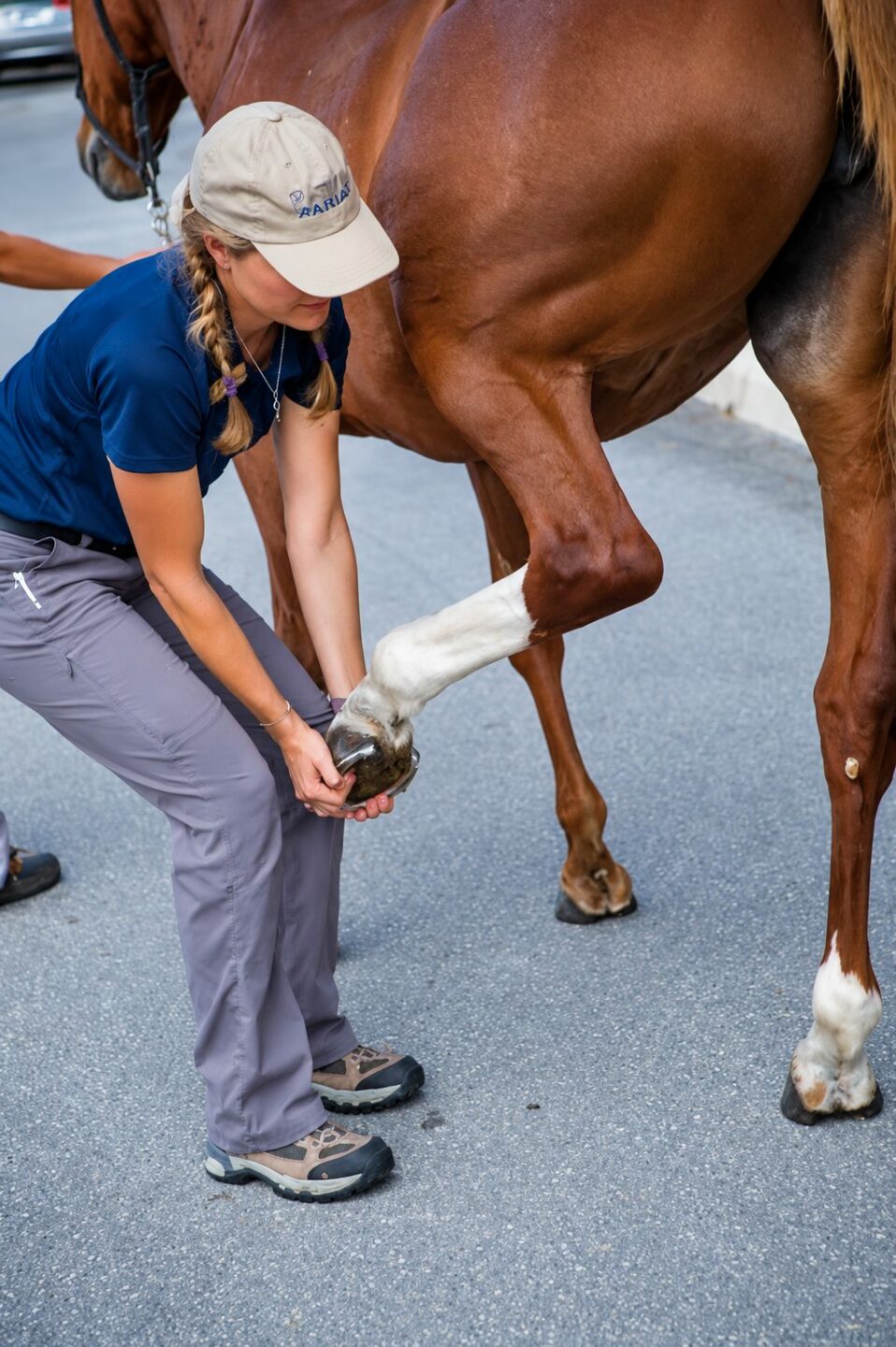
Skilled farriery helps maintain correct hoof balance, with veterinary input where necessary. Attention to the safety of the horse’s environment is equally important, particularly where conditions could contribute to falls, slips or incidents involving other horses.
Observation is another cornerstone of prevention: familiarity with a horse’s usual movement and behaviour makes it easier to recognise potential abnormalities at an early stage.
What Does a Lameness Examination Involve?
The veterinarian tailors the assessment to the horse’s history and clinical condition. Not every horse requires the same investigations, nor will every procedure necessarily be performed during a single examination.
The assessment may include:
- History-taking. A discussion with the owner, rider or trainer helps establish when the problem began, the circumstances in which it occurs and any changes that have been observed.
- Clinical examination and palpation. The veterinarian checks for swelling, tenderness and other abnormalities that may guide further investigation.
- Gait assessment. The horse is observed in hand and, where appropriate, on the lunge or under saddle to assess its movement and any compensatory patterns.
- Flexion tests. Where indicated, these can provide additional information to help localise the problem.
- Diagnostic analgesia. Nerve blocks or other diagnostic anaesthetic procedures may help identify the region from which the pain originates.
- Diagnostic imaging. Depending on the clinical findings, the veterinarian may use radiography or ultrasonography, or recommend further investigations such as scintigraphy, magnetic resonance imaging or computed tomography.
The aim is to reach a diagnosis that informs treatment, rehabilitation and a return-to-work plan tailored to the individual horse. Recognising a change and investigating it promptly means placing the horse’s health at the heart of every sporting decision.
Alessandra Ceserani
© Rights Reserved.