VDL Stud and OPU-ICSI: breeding out of passion, not commerce
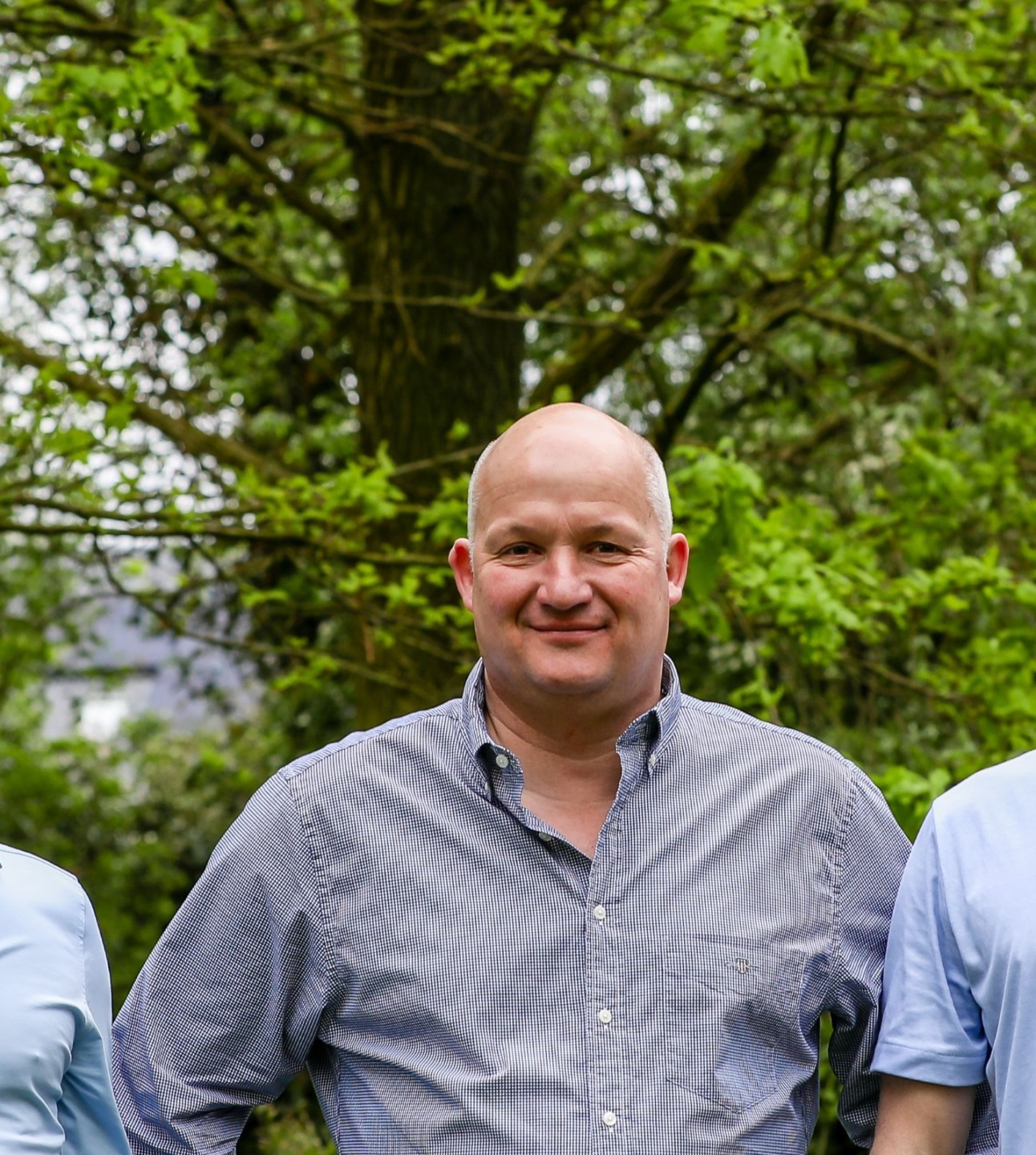
VDL Stud is among the absolute elite of international showjumping breeding. Wiebe Yde van de Lageweg, one of the driving forces behind the stud, speaks candidly about the role of OPU-ICSI within his breeding operation. A technique he employs with conviction, but always guided by the philosophy of the true breeder.
A pragmatic beginning
Around ten years ago, VDL Stud gained its first experience with OPU-ICSI. After a number of years the technique was set aside for a while, but the first foals from the second crop are now six years old. The motivation was pragmatic: there were mares that could no longer get in foal and from which no embryos could be flushed. “For those mares, OPU-ICSI was the only option,” says Van de Lageweg. “And we have good mares, like Banda de Hus, Supardi, Derly Chin de Muze, Donnatella, Fortus Fortuna, Jeleena de Muze and Becherry.”
In two mares that were still actively competing in sport, the technique was used to nonetheless preserve their offspring. Both cases went well. It was the first time VDL Stud had used OPU-ICSI, that was the first generation. In the second round, the technique was deployed more broadly.
Breeder or multiplier
Those good mares are precisely the reason why OPU-ICSI has since become a fixture within VDL Stud’s breeding programme. These are mares of great genetic value, or mares that have performed exceptionally in sport or their offspring, but that can no longer produce offspring through conventional means. Thanks to OPU-ICSI, they remain valuable contributors to the breeding programme. The technique also makes it possible to use semen from stallions whose quality or availability is too limited for conventional fertilisation, such as Cardento, Baltic VDL and Etoulon VDL.
It is emphatically not a commercial endeavour. “Our goal is to keep genetically valuable mares more intensively involved in breeding,” Van de Lageweg explains. “I hope that in this way we can breed a few good stallions and mares from those mares.” That vision has not changed over the years, and that is no coincidence. For Van de Lageweg, the distinction between a breeder and a multiplier is fundamental. “If you run your breeding operation purely from a commercial perspective, you are a multiplier. If you do it with a purpose, out of love for the craft, and you try to advance the breeding, then you are a breeder.”
When asked whether there are mares or stallions he wishes in hindsight had been used via ICSI earlier, the answer is no. The technique simply did not exist at the time it might have been relevant. “Perhaps we would have used it with the mares (Aziemieka, Hyazinthe, Helena, Shoraya), through which we built everything,” he says, “but that is reasoning in hindsight.” With stallions, the situation is different. VDL Stud prefers not to use old stallions for OPU-ICSI. Nimmerdor is an exception, but that was an emotional choice. “We believe you have to move with the times and think ahead. That is why we also use stallions like Baltic VDL and Etoulon VDL, they are not old stallions, and we achieve good results with them.”
Passion as a common denominator
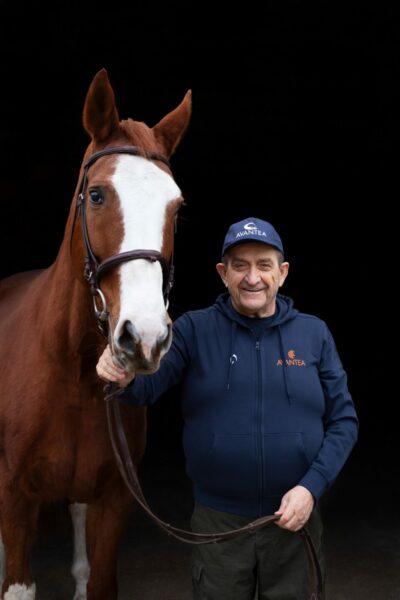
The collaboration with Avantea and the university clinic in Utrecht forms the technical backbone of all this. Avantea was the first provider of OPU-ICSI at the time, and Utrecht was the only place where the OPU could be performed. VDL Stud initially worked there with Tom Stout, and now works with Anthony Claes. “We work very well with Anthony and the trust is great,” says Van de Lageweg. Since a couple of years now, we have also been able to do OPU here at our own place in cooperation with Tineke de Haan of Equilife. Last year, Van de Lageweg visited Avantea himself to view the laboratories and deepen his understanding of the technique. What struck him most was the dedication of the people there. “They are passionate about their work. They are truly people who love what they do and we recognise that in ourselves.”
Rising results, a level-headed view
That passion translates into ever-improving results. The percentage of embryos that successfully implant in recipient mares and are carried to term has risen from around 50 percent in the beginning to approximately 83 percent today. This improvement is due to several factors: the quality of the embryos themselves has increased, the techniques for freezing and thawing have been refined, and the recipient mares also play a crucial role. Good, healthy recipient mares are essential. “It starts with a good egg, then fertilisation, then the growth of the embryo,” Van de Lageweg explains. “After that, everything must be shipped, thawed and transferred in the right way, in a way that gives the embryo a chance. Everything in that chain must be executed perfectly to achieve the best result.”
On the health of ICSI foals, Van de Lageweg is clear: so far he sees no difference compared to foals born through AI or embryo transfer. They are not smaller, not less healthy. “In a few years we will have a better picture, but for now I see no difference.” He emphasises that a mare can always produce a less successful foal, that is a natural process, regardless of the technique used. If a mare produces ten offspring, there will always be a few that are less quality. That applies equally to mares used for OPU-ICSI, embryo flushing or AI.
Blind to the pedigree
What does concern him is the way the market treats ICSI foals. Buyers are fixated on the pedigree, without assessing the animal itself. “A foal with an impressive pedigree gets bought despite its flaws, whereas the very same foal with a lesser pedigree would have been passed over because of those same flaws. That has nothing to do with quality selection.” With an embryo you cannot yet see it, but even with an ordinary foal it is still bought purely on paper. This phenomenon is, according to Van de Lageweg, symptomatic of a broader trend in the embryo trade, where multiplication has become the goal rather than breeding. “That does not benefit the breeding industry and that is not their goal either. Their goal is multiplication. It just stands apart from the method itself.”
Progress at a price
He also understands the criticism of OPU-ICSI itself. It is an intervention and that is exactly what it is. “It is not the same as flushing an embryo or getting a mare in foal directly, it is less natural.” But boundaries shift along with developments, and those techniques also offer opportunities. The next step is sexed semen, and after that something new will follow. “You can say you want no part of it, but at some point you have to.” At the same time, there is something he would rather not lose: the surprise, the charm, the natural element of breeding. “When that disappears, it is no longer breeding to me.”
Two faces
Within VDL Stud’s stallion operation, OPU-ICSI therefore has two faces. On one hand it offers opportunities: it makes it possible to still use valuable stallions such as Cardento, Baltic VDL, Etoulon VDL or even Jus de Pomme. The five-year-old Aston VDL (Aganix du Seigneur – Derly Chin de Muze x For Pleasure) was himself born via ICSI, tangible proof of what the technique can deliver.
On the other hand, there is a darker side that Van de Lageweg does not leave unspoken. Straws of Cardento are circulating that are not permitted to be used, and multiple people are involved in this. “In principle that is simply criminal,” he says without hesitation. Legal action is difficult to pursue, and those involved deliberately exploit that situation. “Most people know full well that they are not allowed to use the semen, but they don’t care, because for them it is purely commercial gain.” It is what he calls ‘milking embryos’ and in his view, it has nothing whatsoever to do with what breeding should be. “I find that truly unacceptable.”
Proof at 1.50 metres
That the technique meanwhile also delivers results that truly matter is demonstrated by the ten-year-old Mr. Blue, born from the mare Doklahoma VDL (v. Baloubet du Rouet), who is now competing at 1.50m under M. Ladoklahoma VDL Z. An ICSI foal that is proving its worth in sport, which is exactly what VDL Stud is all about.
Adriana van Tilburg
© Rights Reserved.