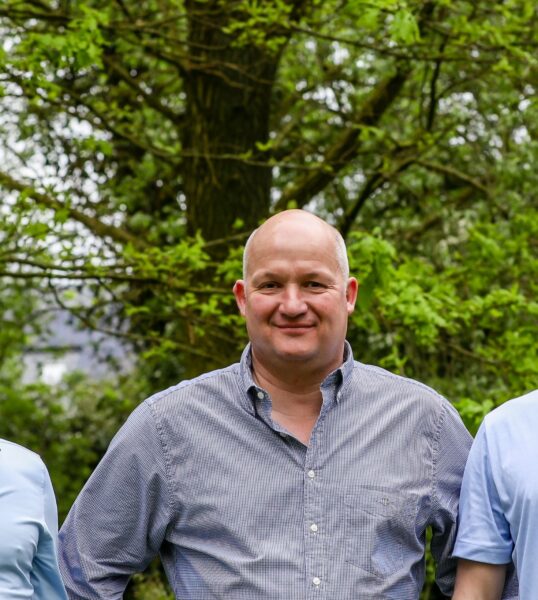
Johan Veldeman and Avantea: «Recognising quality starts with learning to look»

Stal de Regor grew out of the breeding programme established by Johan Veldeman’s father, Roger Veldeman. Yet the foundations of Johan’s eye for horses were laid even before he became involved in horse breeding himself. The family ran a farm and regularly attended markets and livestock shows, where cattle and bulls in particular were assessed. As a young boy, Johan learned not simply to look, but above all to understand why one animal possessed more quality than another. “As a child, I would walk down a line of perhaps ten bulls with my father. He would point to the fourth one and say, ‘That is the best one.’ Then he would explain exactly why. We really looked at everything. That is how you learn to look and develop a feel for quality.”
When Johan got his first pony at the age of twelve, his attention increasingly shifted towards horses. He took part in annual markets and shows, where conformation was the main consideration at the time. A horse did not need to jump or move spectacularly: its build had to be correct. “We mainly looked at the strength of the feet, legs and back. A good walk was also very important. Those are things I still take into account when assessing horses today.”
Nevertheless, his definition of a quality showjumper has changed considerably over the years. Showjumping has evolved and now requires different attributes from a horse than it did several decades ago. “What people once considered a good horse may be almost worthless today. Everything has changed: the speed, the flexibility and the attitude a horse needs. In the past, it was sometimes more a matter of pulling and pushing. We were LRV riders, and there is absolutely nothing wrong with that, but it bore little resemblance to international top-level sport as we know it today.”
Moving with the times
The Veldeman family therefore reached a point when they realised that their breeding programme needed to take a different direction. “We had to do something different with our horses and move with the times.” Their search for an exceptional mare led them to Joris de Brabander and ultimately to Centa de Muze.
That choice did not come out of nowhere. Johan had previously seen Walnut de Muze, Walloon de Muze and Werly Chin de Muze competing in the young-horse classes as five-year-old mares. The three full sisters made a great impression on him. “I genuinely thought they were three exceptional mares. A few years later, we went to Joris and I saw Centa de Muze. I was immediately taken with her. We did not buy her straight away, but once I was home, I studied everything carefully again. It then became clear that she came from an exceptionally strong dam line.”
At that point, the three full sisters had not yet achieved the performances at 1.60m level for which they would later become known. Walloon de Muze, for example, was only six years old when the three-year-old Centa was purchased. “In hindsight, a decision like that naturally seems much easier. I had seen the three sisters as five-year-olds and they all showed a great deal of quality, but they were not yet the mares they would later become. The presence of Qerly Chin in the dam line was decisive for me.”
Centa de Muze could not be used for sport and, at the time, she was the most expensive horse the Veldeman family had ever bought. It was therefore a very deliberate investment in the future of their breeding programme. In the years that followed, the dam line would only grow stronger.
The most difficult group
According to Johan, it is not especially difficult to pick out the very best or the least talented horses in a group. True horsemanship is required when assessing the large group in between. “Anyone can pick out the best one, and the least talented one as well. But the horses that fall just between those two extremes are much more difficult to assess. Our selection starts when they are two years old, when I loose-jump them. At that age, they are what they are. You can improve a horse through training, but you cannot turn it into a completely different horse. Its way of jumping will always remain recognisable.”
His experience has taught him that the original quality will eventually resurface. “Every horse that jumped well as a youngster shows that quality again later. It may temporarily be less convincing at the age of four or five, but as they mature, that quality returns.”
Alongside the way a horse jumps, Johan continues to attach great importance to correct conformation. Above all, the limbs, legs and feet must be good. An imperfect leg conformation does not necessarily prevent a successful sporting career, but when he has a choice, he prefers a correctly built horse. “A horse that toes out can still become a very good sport horse. Even so, I prefer it to be correct. People say for good reason that everything is easier with a correctly built horse.”
His own breeding programme proves that conformation and jumping quality need not be mutually exclusive. Kerly de Regor, Ohaj de Regor and Tell Me de Regor all became national conformation champions and also won the loose-jumping final. “Good conformation is, of course, a very broad concept. One person focuses more on one aspect, while someone else looks at another. For me, good legs and feet remain particularly important.”
At the same time, Johan understands that breeders and stallion-selection committees sometimes face a difficult dilemma. “At a stallion selection, you occasionally see a very good horse with uneven feet. It is then difficult to reject such a stallion solely for that reason.
Performance and instinct
When selecting stallions, Johan studies not only the stallion himself, but also his offspring and their results in sport. Whenever possible, he also assesses leg conformation at stallion selections. He does not travel specifically to see every stallion in person; videos can also provide valuable information.
Yet not every decision can be explained entirely rationally. Instinct plays a major role. “I have had my mare standing in the examination stocks at the stallion station and decided there and then which stallion I was going to use. Sometimes I keep thinking about the offspring of different stallions while I am on the road and change my choice at the very last moment. It is not always connected to a particular bloodline. At times like that, I really work from instinct.”
In doing so, he tries to bring together all the available information. “The performances of the stallion and his offspring are very important. But breeding is not simple. You have to take everything into account.”
Centa de Muze’s prepotency
Centa de Muze’s offspring differ greatly in colour and appearance. Nevertheless, Johan recognises the same essential qualities time and again. “Regardless of which stallion we use and whether an offspring is produced through ICSI or conceived naturally, almost all of them are a different colour. But I see clear similarities in their way of jumping and their technique. In terms of conformation, they also all have sufficient frame. They are big enough and have good limbs.”
In fact, it became clear from Centa’s very first offspring that she was no ordinary broodmare. Her first foal was Freestyle de Regor. “At the beginning, of course, you still have to discover what a mare actually passes on.” Her second foal, the Obourg son Horizon de Regor, provided Johan with further important information about her prepotency. “Horizon was not the most beautiful. He really toed out and was not particularly strong through his back. When he was born, I honestly thought, ‘Good grief.’ Based on the mating, I had expected him to be an attractive horse. But he turned out to be an exceptionally good jumper and had a successful sporting career with Jos Lansink and Pieter Clemens.”
Horizon, in particular, taught Johan that Centa’s most important qualities were not always immediately apparent from the appearance of her offspring. “That is when you begin to realise that the mare passes on something truly special. We continued using different stallions and, in fact, few if any of her offspring have disappointed. They are all jumpers and they are willing to work. That is exceptional, and they are proving it in sport as well.”
Johan also expects several more good sport horses from this line to emerge, as the oldest offspring of Centa de Muze produced through ICSI are only seven years old.
Proven stallions though ICSI
The introduction of OPU/ICSI has partly changed his choice of stallions. When using this technique, Johan deliberately selects proven stallions. The method was crucial for Centa de Muze, because it was no longer possible to obtain foals from her through other reproductive techniques.
One of the stallions who proved to be an excellent match for her was Chacco-Blue. “I used Chacco-Blue several times. His way of jumping appealed to me, as did his type. He was also a stallion with sufficient frame. In 2019, I had five full siblings by him out of Centa de Muze.”
That group includes the now seven-year-old Toemme de Regor Z and Toyboy de Regor. Both are approved breeding stallions and are developing extremely well in sport. Their full sister Tell Me de Regor is also performing well. “All three look different, but they are much more alike in the way they jump.”
Johan sees no difference between horses produced through ICSI and horses conceived conventionally. “Not at birth and not later, either. To me, they are simply the same horses.”
In an ICSI programme, he aims to obtain at least two embryos. There are both breeding and economic reasons for this. “I am satisfied when I have two embryos. The next step, of course, is for those to result in two healthy foals. Two is important to me because it also allows me to cover the costs. I can retain one offspring and sell the other.”
Enjoying an exceptional mare for longer
For Johan, the greatest value of the technique developed and applied by Avantea lies in the additional opportunities it has given a mare such as Centa de Muze. Without OPU/ICSI, her contribution to the breeding programme would have ended years earlier. “Just imagine if I had no longer been able to use Centa de Muze for breeding eight years ago. We would never have had some of these wonderful horses. I genuinely tried everything, and Avantea gave me the opportunity to breed more offspring from Centa and to enjoy them. That makes an enormous difference to me.”
At Stal de Regor, tradition and modern reproductive techniques therefore come together. The eye with which Johan Veldeman assesses a two-year-old today still has its origins in the markets and livestock shows he attended with his father as a child. The possibilities for preserving the quality he learned to recognise there for another generation have changed fundamentally. Yet the essence of his breeding programme has remained the same: looking carefully, studying performance and, at the decisive moment, daring to trust his own instinct.
By Adriana van Tilburg
Photo Courtesy of Wil Smeets Horse Photography
© Rights Reserved.