The Champions Who Made FEI World Equestrian Games Dressage History
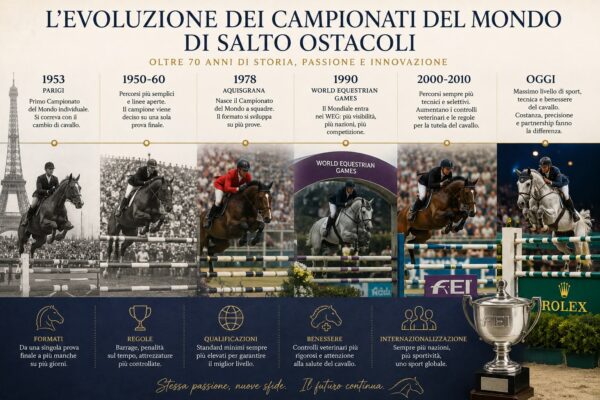
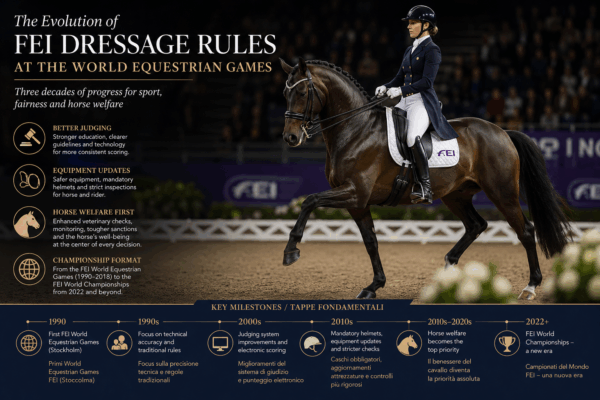
For nearly three decades, the FEI World Equestrian Games were the pinnacle of international dressage. From 1990 to 2018, the world’s finest horse and rider combinations competed for one of the sport’s most prestigious titles. Throughout those years, dressage evolved significantly. Rules changed, judging became more refined, horse welfare gained greater importance, and the definition of excellence continued to develop.
Yet what made the World Equestrian Games truly unforgettable were the riders and horses who defined each era and left a lasting legacy on the sport.
Nicole Uphoff and Rembrandt, the beginning of an era
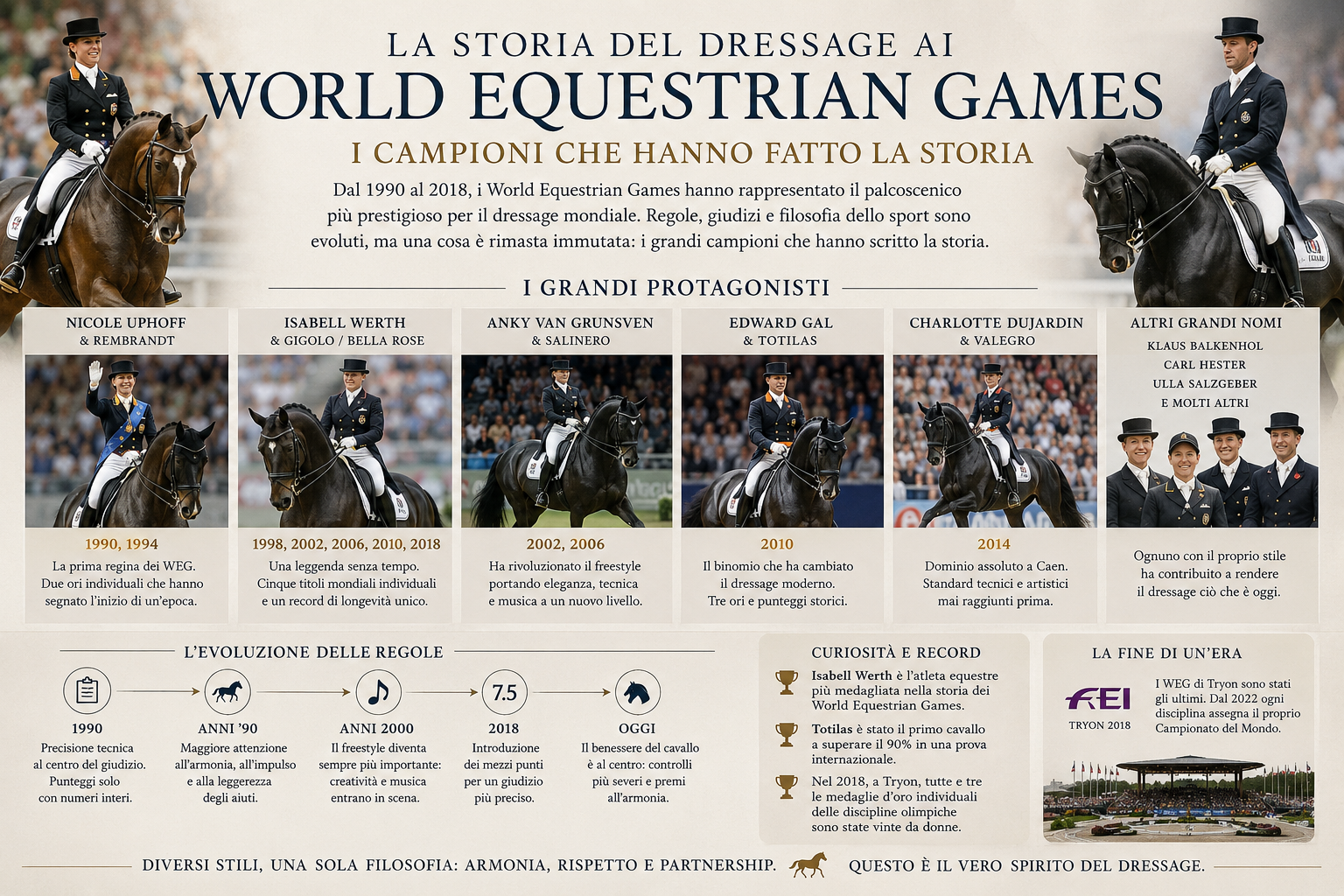
The inaugural FEI World Equestrian Games were held in Stockholm in 1990, where Germany immediately established its dominance through Nicole Uphoff and the legendary Rembrandt.
Their victory marked more than just a world title. It introduced a new standard of elegance, harmony, and precision that influenced dressage for years to come.
When they defended their individual world title in The Hague in 1994, they became the first true legends of the World Equestrian Games.
Isabell Werth, the undisputed queen of the World Equestrian Games
No rider has shaped modern dressage more than Germany’s Isabell Werth.
Competing with exceptional horses such as Gigolo FRH, Satchmo and Bella Rose, Werth has remained at the top of the sport for more than three decades. Her first individual World Championship title came in Rome in 1998 with Gigolo, beginning one of the greatest careers in equestrian history.
Twenty years later, at the final FEI World Equestrian Games in Tryon in 2018, she once again claimed the individual world title aboard Bella Rose, proving that excellence has no age.
Today, Isabell Werth remains the most decorated equestrian athlete of all time.
Anky van Grunsven, the rider who transformed freestyle
During the early 2000s, freestyle dressage became one of the sport’s highlights.
No one influenced this discipline more than Dutch rider Anky van Grunsven.
Together with Salinero, she introduced a new level of musical interpretation, technical precision and artistic expression. Although she is best known for winning three consecutive Olympic individual gold medals, Van Grunsven was also one of the leading figures at the World Equestrian Games, inspiring a new generation of dressage riders.
Charlotte Dujardin and Valegro, the perfect partnership
The 2014 FEI World Equestrian Games in Caen marked the arrival of a new generation.
Charlotte Dujardin and Valegro dominated the competition, producing performances that combined outstanding technical accuracy with remarkable lightness and harmony.
Valegro is still regarded as one of the greatest dressage horses in history, admired for his athleticism, expressive movement and willingness to perform.
Their performances raised the standard for modern championship dressage.
Edward Gal and Totilas, the horse that changed the sport
Few horse and rider combinations have had as much impact as Edward Gal and Totilas.
At the 2010 FEI World Equestrian Games in Lexington, the Dutch pair won three gold medals, Team, Grand Prix Special and Freestyle.
Totilas became the first dressage horse to score over 90 percent in international competition, capturing the attention of audiences well beyond the equestrian world.
His spectacular movement, elasticity and charisma transformed public interest in dressage and inspired countless riders around the globe.
Klaus Balkenhol, the master of classical riding
During the 1990s, Germany’s Klaus Balkenhol and Goldstern became admired for a riding style built on harmony, lightness and respect for the horse.
Although less spectacular than some of his rivals, Balkenhol became one of the strongest advocates of classical dressage principles, and his philosophy continues to influence trainers and riders worldwide.
Carl Hester, the mentor behind champions
Great Britain’s Carl Hester is remembered not only for his own championship performances but also for transforming British dressage.
As Charlotte Dujardin’s mentor, he helped build one of the most successful partnerships in the history of the sport. His training philosophy, based on patience, horse welfare and correct development, has become a model for modern dressage.
Ulla Salzgeber, Germany’s precision specialist
At the turn of the century, Ulla Salzgeber was one of Isabell Werth’s strongest competitors.
Riding Rusty, she collected multiple World Championship medals and helped Germany maintain its position as the leading nation in international dressage through consistently elegant and technically accurate performances.
A history written by both men and women
One of the unique qualities of dressage is that men and women compete against one another on equal terms.
The FEI World Equestrian Games showcased some of the greatest female athletes in equestrian history, including Nicole Uphoff, Isabell Werth, Charlotte Dujardin and Anky van Grunsven. At the same time, outstanding riders such as Edward Gal, Carl Hester and Klaus Balkenhol played equally important roles in shaping the sport.
Together, they helped transform dressage into the discipline it is today, combining technical excellence, harmony, athleticism and an ever-growing commitment to horse welfare.
From the World Equestrian Games to the FEI World Championships
The 2018 edition in Tryon marked the end of the FEI World Equestrian Games.
From 2022 onwards, each FEI discipline returned to its own standalone World Championship, bringing an end to an event that had united all equestrian sports under one banner. Tgis year in 2026 we will finally see the WEG happen agian, all disciplines will be brought together in Aachen this August.
Although the World Equestrian Games are now part of history, their legacy lives on.
They witnessed the evolution of dressage, from the technical precision of the early years to today’s emphasis on harmony, partnership and horse welfare.
Above all, they introduced the world to unforgettable horse and rider combinations. Nicole Uphoff and Rembrandt. Isabell Werth and Gigolo. Edward Gal and Totilas. Charlotte Dujardin and Valegro.
These names represent far more than medals. They are the champions who shaped the history of dressage.
© Rights Reserved.